Urban Economics and Planning

Urban Economics and Planning


Journal Metrics

(From 2022)

 https://www.juep.net/journal/metrics?lang=en

Date Created

2022

Number of Volumes

8

Number of Issues

37

Submission Count

1,041

Number of Articles

393

Article View

424,912

PDF Download

221,762

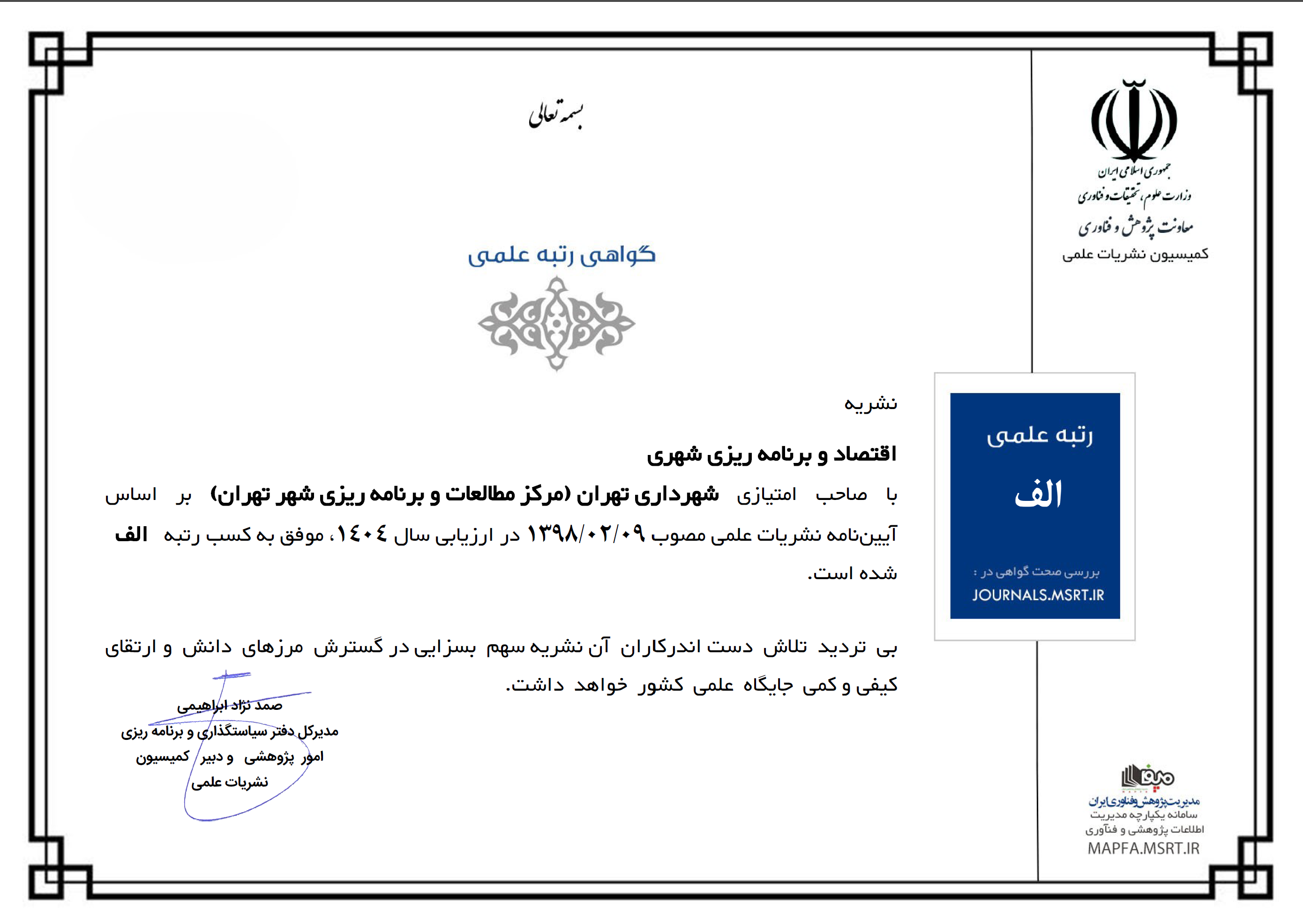
Urban Economics and Planning is a peer-reviewed academic journal that, in the latest evaluation by the Ministry of Science, Research, and Technology (2024), has been awarded the Scientific Grade “A”. The journal is published by the Tehran Urban Planning and Research Center and focuses on topics related to urban economics and urban planning.

Authors are kindly requested to submit their manuscripts electronically through the “Submit Paper” section and to track the peer-review process via the online system. Submitted papers will be published upon successful completion of the review process and after making any required revisions.

In order to enhance the journal’s international visibility and academic reach, from Volume 7, Issue 1 (March 2026) onward, the journal will be published bilingually (in Persian and English). Accordingly, authors whose papers are submitted to the system on or after October 7, 2025, are required to provide an English version of their accepted manuscripts.

Since May 31, 2023, all submitted papers have been checked for plagiarism through the Samim Noor plagiarism detection system. Uploading the similarity report and specifying the journal’s email address (info@juep.net) as the recipient on the originality certificate are mandatory when submitting manuscripts.

The processing of all manuscripts submitted after June 22, 2022, is free of charge.


.Journal of "Urban Economics and Planning" 

Publication Period Monthly
Reviewing and Evaluating process Double-blind
Acceptence Rate (2024) 31%
Language Persian and English
Kind of Publication Print and Online
Plagiarism monitoring software SamimNoor
Submission and Publication fee Completely Free (Sponsered by Tehran Urban Research and Planning Center)
Publication license and copyright Creative Commons license CC-BY 4.0
Review Time 2 weeks approximately (2025)
Article Access

Platinium Open Access

Archiving

ISC (in addition to journal website)


Keywords Cloud

  • Tehran
  • Smart city
  • sustainable development
  • urban management
  • Tabriz City
  • Tehran Municipality
  • Urban planning
  • Spatial justice
  • Quality of Life
  • Urban regeneration
  • Tourism
  • Urban Governance
  • Citizen participation
  • Urban Development
  • Tehran City
  • Mashhad
  • Sustainable urban development
  • content analysis
  • Social Capital
  • livability
  • Iran
  • Resilience
  • Environment
  • Urban Resilience
  • Regeneration
  • structural equation modeling
  • Tehran Metropolis
  • Urban Economy
  • municipality
  • Informal Settlement
  • urban tourism
  • Future Study
  • Systematic review
  • Tabriz
  • Neighborhood
  • spatial inequality
  • Sustainability
  • SWOT Analysis
  • City
  • Housing
  • smart governance
  • Renewable Energy
  • Development
  • Historical context
  • Grounded theory
  • housing price
  • Pathology
  • Financing
  • Social Justice
  • urban space
  • Tehran Metropolitan Region
  • Economic impacts
  • employment
  • urban development plans
  • Environmental Quality
  • SWOT
  • Thematic Analysis
  • Multi-criteria decision making
  • Behbahan City
  • urban entrepreneurship
  • Integrated Urban Management
  • Social Sustainability
  • Qazvin city
  • Futures Studies
  • Multi-Criteria Decision-Making
  • Smart Tourism
  • spatial structure
  • Sanandaj
  • Artificial intelligence
  • Kermanshah
  • Informal Settlements
  • Air pollution
  • mental health
  • Uncertainty
  • revitalization
  • Meta-Synthesis
  • affordable housing
  • Sensitivity analysis
  • Foresight
  • social network analysis
  • Urban Design
  • Land Price
  • Sense of Place
  • Urban sustainability
  • urban branding
  • land use
  • Place
  • Regional Development
  • Global Experiences
  • Zahedan City
  • climate change
  • Machine Learning
  • Urban Identity
  • Passive Defense
  • Policy making
  • Peri-urban areas
  • Elderly
  • socio-cultural
  • Space Syntax
  • Stable Security
  • social network analysis (SNA)
  • Urban Profile
  • Sustainable development indicators
  • Sustainable Income
  • Information technology
  • Iranian economy
  • Branding
  • Bibliometric analysis
  • Sanandaj city
  • Efficiency
  • Strategic Planning
  • Entrepreneurship
  • Systematic literature review
  • Place Attachment
  • urban fabric
  • planning
  • Creative tourism
  • District 7
  • Cultural Identity
  • Urban Livability
  • Qom City
  • scenario writing
  • informal economy
  • Isfahan City
  • Actors
  • Third Place
  • Urban Space Quality
  • city development
  • Public Participation
  • urban poverty
  • Urban landscape
  • Fuzzy Delphi
  • Cultural capital
  • crime
  • Quality of Urban Life
  • Founding
  • Environmental Security
  • participatory governance
  • Mashhad Metropolis
  • Urban Financing
  • technology
  • Participation
  • urban environment
  • lived experience
  • Gentrification
  • spatial analysis
  • Social Resilience
  • Urban Development Plan
  • Prosperity
  • Assessment
  • Ecotourism
  • local economy
  • Scenario
  • Collective Memory
  • Tehran Metropolitan Area
  • Infill development
  • tourism infrastructure
  • Social participation
  • GIS
  • Co-occurrence
  • Innovation
  • Environmental justice
  • metropolises of Iran
  • Business
  • Detailed plan
  • Urban Heat Island
  • Spatio-temporal analysis
  • Cost-Benefit
  • MICMAC
  • Place Identity
  • Right to the city
  • Kerman City
  • Family
  • Tabriz Metropolis
  • Conceptual model
  • Economic Development
  • Sustainable Transportation
  • Critical realism
  • Public-Private Partnership (PPP)
  • Residential Satisfaction
  • model
  • return on investment
  • neighborhoods
  • Impact Assessment
  • Financial Development
  • urban health
  • Ardabil City
  • Security
  • Shopping Centers
  • Place dependence
  • Qualitative Content Analysis
  • Worn Texture
  • Isfahan
  • Social Interactions
  • Hermeneutics
  • Conflict of interest
  • Value Added Tax
  • positive core
  • Infill Buildings
  • Kan Neighborhood of Tehran